
Integrating Hammett Constants with DFT Descriptors to Predict Binding Affinity toward Human DNA Topoisomerase I
DOI:
https://doi.org/10.67364/mp6mzv57Keywords:
Human DNA Topoisomerase I (1T8I), Density Functional Theory (DFT), Hammett σp ConstantsAbstract
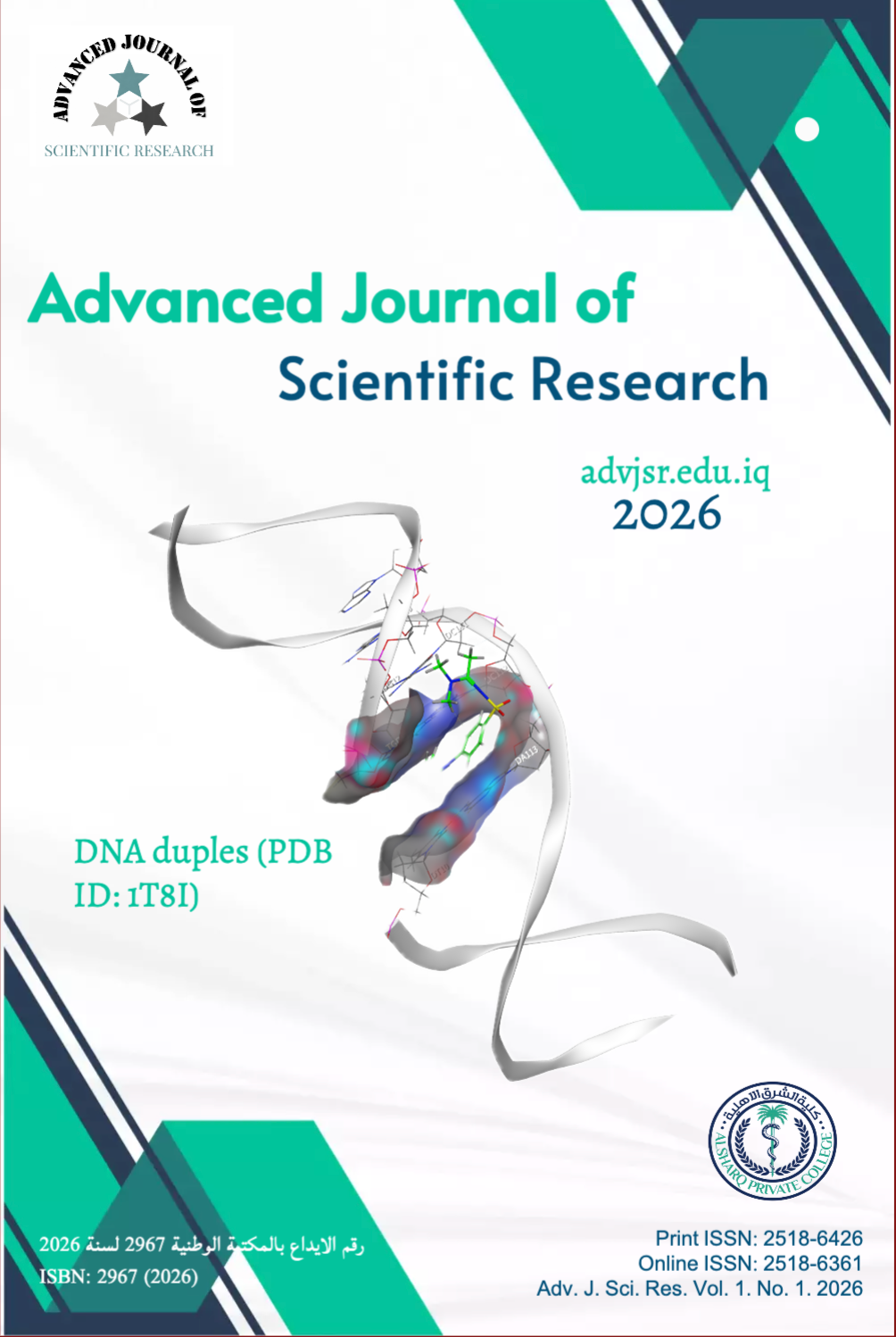
A systematic investigation of the structure-activity relationship (SAR) for a set of para-substituted aromatic compounds (where X = H, Me, OMe, Cl, CN, and NO2) was carried out to elucidate the impact of electronic effects on binding affinity with Human DNA Topoisomerase I. DFT calculations were carried out to obtain frontier molecular orbital energies (EHOMO and ELUMO), bandgaps (ΔE), and Mulliken charge distribution (N1 and N2). Docking simulation was carried out against the crystal structure of Human DNA Topoisomerase I.
The docking simulation showed good binding affinities for all compounds, with S-score values between −7.24 and −7.69 kcal/mol. Electron-withdrawing substituents (Cl, CN, and NO2) showed higher binding affinities than those of electron-donating substituents. Among these, NO2 showed the highest binding affinity (−7.6894 kcal/mol). π-π stacking interactions were observed with DNA base pairs (DA113 and TGP11), similar to those of the Topo I-DNA cleavage complex. A significant relationship was observed between Hammett constants σp and docking scores, showing a direct relationship between increasing electron-withdrawing effects and binding affinity. Moreover, statistically significant correlations were also found for the correlations of the values of σp with the energies of the LUMO orbitals and the Mulliken charge values at the N1 and N2 positions, which emphasize the importance of the electronic density redistribution effect for the modulation of molecular recognition processes.
The integrated DFT–Hammett–Docking model offers a quantitative understanding of the electronic modulation effect of substituents and the impact of this effect on the inhibition of Topoisomerase I. The results of this study offer predictive insights for the rational design of novel anticancer agents targeting Human DNA Topoisomerase I.
References
[1] R. Cincinelli, L. Musso, S. Dallavalle, R. Artali, S. Tinelli, D. Colangelo, N. Zaffaroni, Design, modeling, synthesis and biological activity evaluation of camptothecin-linked platinum anticancer agents, Eur. J. Med. Chem. 63 (2013) 387–400.
[2] Z.L. Song, H.L. Chen, Y.H. Wang, M. Goto, W.J. Gao, P.L. Cheng, K.H. Lee, Design and synthesis of novel PEG-conjugated 20 (S)-camptothecin sulfonylamidine derivatives with potent in vitro antitumor activity via Cu catalyzed three-component reaction, Bioorg. Med. Chem. Lett. 25 (2015) 2690–2693.
[3] P. Bansode, J. Jadhav, R. Kurane, P. Choudhari, M. Bhatia, S. Khanapure, G. Rashinkar, Potentially antibreast cancer enamidines via azide alkyne amine coupling and their molecular docking studies, RSC Adv. 6 (2016) 90597–90606.
[4] R. Cincinelli, L. Musso, S. Dallavalle, R. Artali, S. Tinelli, D. Colangelo, F. Zunino, M. De Cesare, G. Luca Beretta, N. Zaffaroni, Design, modeling, synthesis and biological activity evaluation of camptothecin-linked platinum anticancer agents, European Journal of Medicinal Chemistry 63 (2013) 387-400.
[5] Y.H. Hsiang, R. Hertzberg, S.M. Hecht, L.F. Liu, Camptothecin induces protein- linked DNA breaks via mammalian DNA topoisomerase I, J. Biol. Chem. 260 (1985) 14873-14878.
[6] L.F. Liu, S.D. Desai, T.K. Li, Y. Mao, M. Sun, S.P. Sim, Mechanism of action of camptothecin, Ann. N. Y. Acad. Sci. 922 (2000) 1-10.
[7] Y. Pommier, Topoisomerase I inhibitors: camptothecins and beyond, Nat. Rev. Cancer 6 (2006) 789-802.
[8] R. Vangala, S. K. Sivan, S. R. Peddi, V. Manga, Computational design, synthesis and evaluation of new sulphonamide derivatives targeting HIV‐1 gp120, Journal of Computer-Aided Molecular Design, 34, (2020) 39–54.
[9] L. P. Hammett, The effect of structure upon the reactions of organic compounds. Benzene derivatives. Journal of the American Chemical Society, 59, (1937) 96–103.
[10] Y. Pommier, Topoisomerase I inhibitors: camptothecins and beyond. Nature Reviews Cancer, 6, (2006) 789–802.
[11] M. Julaiti, P. Sun, B. Aizezi, A. Wusiman, TCT promoted efficient synthesis of N-sulfonyl (form)amidines from sulfonamides and (form)amides, Tetrahedron 189 (2026) 135005
[12] Becke A.D., J.Chem.Phys., 98,5648(1993).
[13] Kohnand W., Sham L., J.Phys.Rev. 140, A1133(1965).
[14] Frisch M.J., W.Trucks M.J., Schlegel H.B., Scuseria G.E., Robb M.A., Cheeseman J.R., Montgomery J.A., Vreven J.T., Kudin K.N., Burant J. C., Millam J. M., Iyengar S. S., Tomasi J., Barone V., Mennucci B., Cossi , Scalmani G., Rega N., Petersson G. A., Nakatsuji H., Hada M., Ehara M., Toyota K., Fukuda R., Hasegawa J., Ishida M., Nakajima T., Honda Y., Kitao O., Nakai H., Klene M., Li X., Knox J.E., Hratchian H.P., Cross J.B., Bakken V., Adamo C., Jaramillo J., Gomperts R., Stratmann R.E., Yazyev O., Austin A.J., Cammi R., Pomelli C., Ochterski J.W., Ayala P.Y., Morokuma K., Voth,P.Salvador G.A., Dannenberg J.J., Zakrzewski V.G., Dapprich S., Daniels A.D., Strain M.C., Farkas O., Malick D.K., Rabuck A.D., Raghavachari K., Foresman J.B., Ortiz J.V., Cui Q., Baboul A.G., Clifford S., Cioslowski J., Stefanov B.B., Liu G., Liashenko A., Piskorz P., Komaromi I., Martin R.L., Fox D.J., Keith T., Al-Laham M.A., Peng C.Y., Nanayakkara A., Challacombe M., Gill P.M.W., Johnson B., Chen W., Wong M.W., Gonzalez C., and Pople J.A., Gaussian03, Revision C.02, Gaussian, Inc., Wallingford, CT 2004.
[15] Essa A. H., Journal of Organometallic Chemistry 692 (2007) 4917–4920
[16] Yates C.M., Garvey E.P., Shaver S.R., Schotzinger R.J., Hoekstra W.J., Bioorg. Med. Chem. Lett 27 (2017) 3243-3248.
[17] Che X., Sheng C., Wang W., Cao Y., Xu Y., Ji H., Dong G., Miao Z., Yao J., Zhang W., Eur. J. Med. Chem. 44 (2009) 4218-4226.
[18] Gomez-García O., Andrade-Pavon D., Campos-Aldrete E., Ballinas-Indilí R., Mendez-Tenorio A., Villa-Tanaca L., Alvarez-Toledano C., Molecules 23 (2018) 599.
Downloads
Published
Issue
Section
License
Copyright (c) 2026 Advanced Journal of Scientific Research

This work is licensed under a Creative Commons Attribution-NonCommercial-NoDerivatives 4.0 International License.